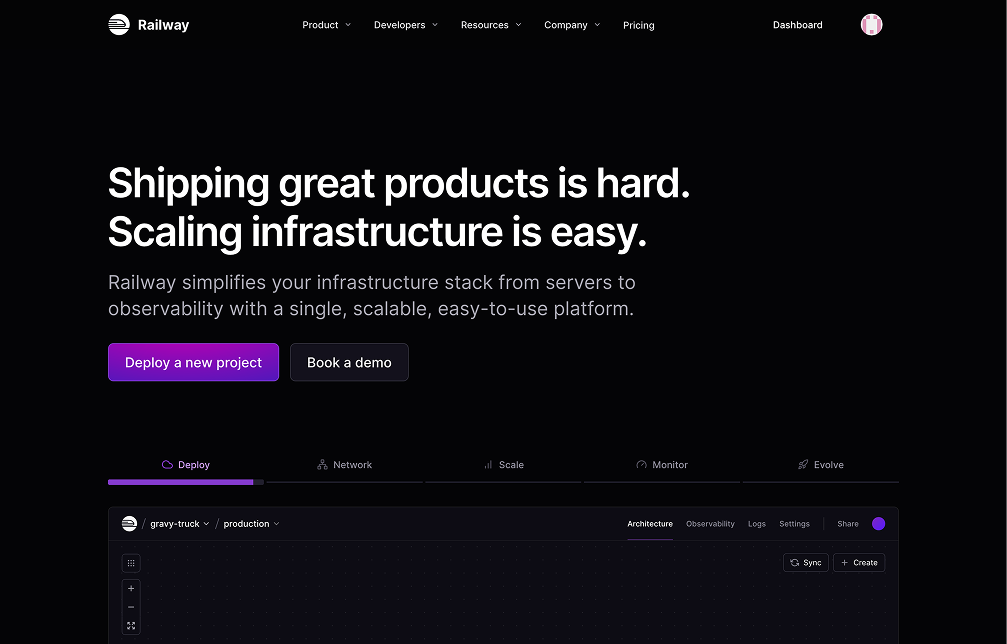
Stop wasting time on infrastructure. Railway is a modern application deployment platform that lets you ship code, not configure clouds. It’s designed for developers who need to move fast, providing a Heroku-like developer experience with a serverless, pay-as-you-go pricing model. Teams using Railway are able to deploy their applications 10x faster and reduce their infrastructure costs by up to 80% compared to traditional cloud providers.
Why Railway is the New Standard for Developer-First Deployment
The Two-Minute Deploy: Connect your GitHub repository, and Railway automatically detects your stack, builds your application, and deploys it. Every git push to your main branch is live in seconds. There are no YAML files to write, no Dockerfiles to perfect (unless you want to), and no complex network configurations. This is a workflow optimized for pure developer velocity.
Infrastructure on Demand: Need a Postgres database, a Redis cache, or a MongoDB instance? Just add it from the Railway dashboard. The service is provisioned in seconds, and the connection string is automatically injected into your application as an environment variable. This eliminates the hours of frustration typically associated with managing stateful services.
Preview Environments for Every Pull Request: This is a game-changer for team collaboration and QA. Every time a pull request is opened, Railway automatically spins up a complete, ephemeral copy of your application stack for review. This allows stakeholders to test new features in a live, production-like environment before they are merged, dramatically shortening feedback cycles and improving code quality.
The Metrics That Matter
- Time to Deploy: Go from a GitHub repo to a live, publicly accessible URL in under 2 minutes.
- Cost Savings: Reduce your monthly infrastructure bill by up to 80% compared to Heroku’s dyno-based model.
- Developer Overhead: Reclaim 10-20 hours per month that would otherwise be spent on DevOps and infrastructure management.
- Free Tier: Every user gets a $5 monthly credit, which is enough to run a small full-stack application with a database for free, forever.
Who Executes with Railway
The Ideal Customer Profile:
- Solo developers and indie hackers launching new products and side projects.
- Early-stage startups (Pre-Seed to Series A) who need to build and iterate on their MVP at high speed.
- Small-to-medium-sized development teams (2-20 engineers) who want to minimize DevOps overhead.
- Companies and developers migrating away from Heroku due to its restrictive and expensive pricing.
The Decision-Makers:
- CTOs and VPs of Engineering at startups who need a platform that enables their team to move fast.
- Solo founders who are building and deploying the first version of their product.
- Engineering Managers who want to empower their developers with a simple, self-serve infrastructure platform.
Common Use Cases That Drive ROI
Rapid MVP Development: A founder has a new SaaS idea. They can build their full-stack application with a Next.js frontend, a Python backend, and a Postgres database, and deploy the entire stack on Railway in a single afternoon. This allows them to validate their idea with real users weeks, or even months, faster than with a traditional cloud setup.
Cost-Effective Side Project Hosting: A developer builds a side project that gets a small but steady amount of traffic. On Railway’s free tier, the project runs with zero out-of-pocket costs. As the project grows, the usage-based pricing scales with it, ensuring it always remains profitable.
Seamless Heroku Migration: A company is facing a $2,000/month Heroku bill. They can migrate their application and database to Railway in a few hours, thanks to the similar deployment model. Their new bill is $350/month, an instant 82% cost saving with no loss in performance or developer experience.
Critical Success Factors
The Pricing Reality Check:
- Free Tier: $5 of usage credit is applied to your account every month.
- Developer Plan: $5/month. This unlocks the ability to spend beyond the free credit on a pay-as-you-go basis.
- Pro Plan: $20/user/month. Includes more usage credits and team-based features like shared environments.
- The Economics: You pay directly for the CPU, RAM, and network egress you consume, with no markup. This is fundamentally fairer and more transparent than seat-based or dyno-based models.
Implementation Requirements:
- Git-Based Workflow: Your project must be in a GitHub or GitLab repository.
- Dockerfile (Optional): For maximum control, you can provide your own Dockerfile, but for most standard frameworks, Railway’s automatic build process is sufficient.
- Environment Variables: You must manage your application secrets and configuration using environment variables, which is a best practice anyway.
The Integration Ecosystem
Git Providers: Deep, native integration with GitHub and GitLab for automated builds, deployments, and preview environments.
Databases & Services: One-click provisioning for PostgreSQL, MySQL, Redis, and MongoDB.
Languages & Frameworks: Built-in support for virtually every modern language and framework, including Node.js, Python, Go, Ruby, Java, and Rust.
The Bottom Line
Railway is the spiritual successor to Heroku, reimagined for the modern era. It provides an unparalleled developer experience that prioritizes speed and simplicity, backed by a fair, usage-based pricing model. It is the ideal platform for any individual or team that wants to focus on building and shipping great products, not on the underlying infrastructure.
For early-stage startups and developers, the choice is clear. The speed, simplicity, and cost-effectiveness of Railway provide a decisive advantage. While it may lack the enterprise-grade features and certifications of the major cloud providers, it is the perfect tool for getting from idea to production in the shortest possible time.